
Programming Laws & Principles
A comprehensive collection of programming laws, principles, and heuristics that guide software engineering decisions.
Funny Programming Laws & Principles
Because the universe clearly hates developers.
If you’ve ever shipped a feature and watched the production logs breathe fire like a dragon with commitment issues, welcome to the club. These “laws” are the distilled, bitter wisdom of people who have stared at a stack trace at 3:00 AM and decided the only sane response was comedy. Read them, weep a little, then laugh preferably after you’ve pushed a hotfix.
Below you'll find each law explained in deliciously nerdy, sarcastic detail. Every entry gets at least two paragraphs because you deserve the full trauma-and-triumph experience.
Murphy’s Law of Programming
"Anything that can go wrong will go wrong, especially in production."

Murphy’s Law is the unofficial thesis statement of software engineering. You can unit-test until your fingers cramp and run your integration tests while chanting incantations, and yet your production environment will discover a brand-new way to betray you. It’s not random cruelty; it’s the inevitable collision of infinite state combinations, unpredictable user behavior, and that one blob of legacy code no one dares to touch. Production is where the real world shreds your beautiful assumptions, and assumptions rarely survive the impact. Why does it feel personal? Because production has a sixth sense for hidden dependencies: a surprise library update, a timezone quirk, file system permissions that enjoy role-playing as puzzles, or a race condition that only triggers when a load balancer sneezes. Mitigation strategies exist (feature flags, canary releases, observability, and the ancient ritual of “log everything and hope”), but they’re not shields; they’re Band-Aids and sometimes life jackets. Murphy doesn’t care about Band-Aids; he just enjoys the spectacle.
Hofstadter’s Law
"It always takes longer than you expect, even when you take into account Hofstadter’s Law."

This one is a cognitive smackdown. No matter how many times you’ve been burned by the planning fallacy, you’ll still optimistically promise deadlines like someone who thinks dragons can be tamed with sticky notes. You factor in some buffer, then Hofstadter’s Law smirks from the corner: your buffer becomes a false sense of security. The truth is, software estimation multiplies unknowns, new edge cases, integration surprises, and the delightful discovery that “small refactor” is actually a memory palace for technical debt.
Want to be slightly less wrong? Break tasks into painfully small chunks and expect your buffer to erode faster than free pizza in a dev room. But don’t kid yourself into thinking you’ll ever be accurate. Project timelines are educated guesses wrapped in developer hubris. Embrace iterative delivery, celebrate tiny wins, and stay on speaking terms with humility. It’s the least painful dependency you’ll ever manage.
Wadler’s Law
Debates about language design follow this pattern:
- Semantics: 2 weeks
- Syntax: 2 months
- Lexical syntax: 6 months
- Logo color: endless
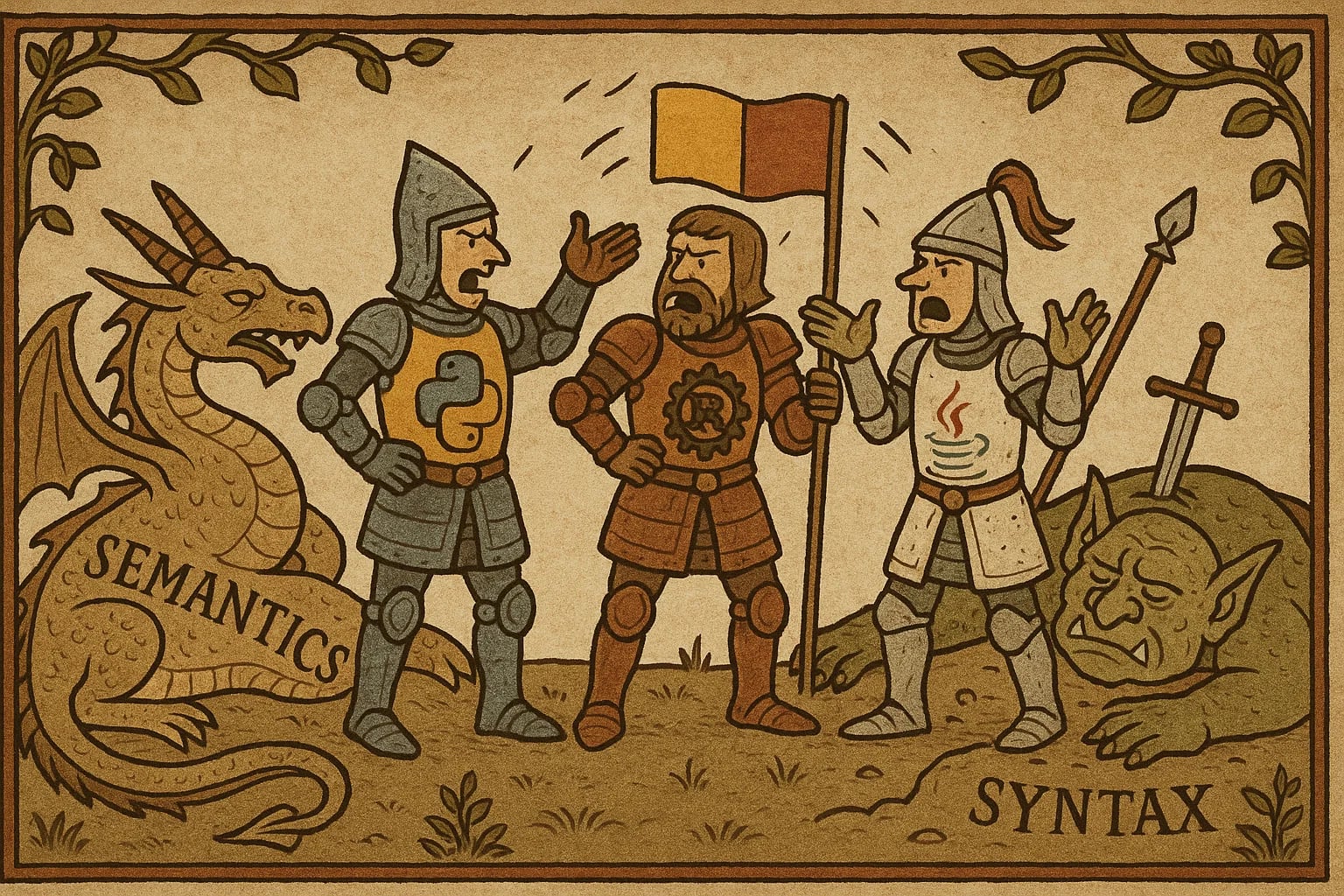
Wadler’s Law is a perfect chronicle of how developer discussions rot. At first, people argue about semantics, the actual meaning and behavior, which is important and usually solvable. Then it slides into syntax fights: shall we use => or ->? That debate drags on for months because bikeshedding is a competitive sport. After that, the conversation descends into lexical nuances and token-level pedantry, because nothing says “progress” like three months of haggling over whitespace.
And then comes the logo. The logo is where reason dies. Suddenly, the community isn’t discussing language ergonomics anymore. It’s forming cults of aesthetic taste over branding palettes. Why does this happen? Because language design invites tribal identity. Once design becomes identity, arguments stop being technical and start being religious. The trick is to keep the focus on developer experience and runtime behavior. But good luck convincing a room full of stakeholders that “teal vs. slightly darker teal” is less important than preventing memory leaks.
Zawinski’s Law
"Every program attempts to expand until it can read mail."
Start with a tidy app that does one thing well. Add one feature, then another, then a plugin system, and suddenly your to-do list app is a bloated monstrosity that syncs calendars, recommends lunch, and—naturally—reads your mail. Zawinski’s Law perfectly captures the inevitability of feature creep. Developers say “this might be useful,” product managers say “let’s ship,” and suddenly the roadmap is a Frankenstein’s monster with Gmail integration stitched on the forehead.

This expansion is fueled by optimism, user requests, and the seductive dream of “one app to rule them all.” The downside is complexity: more state, more configuration, more surface area for bugs, and an onboarding flow that feels like applying for a mortgage. Scope creep can be contained (strict definitions, ruthless roadmaps, merciless product managers), but containment requires discipline, and discipline is boring. So the app keeps expanding, and at some point, your calculator app is handling email and calendar invites. Congratulations, you’ve reinvented Outlook.
Greenspun’s Tenth Rule
"Any sufficiently complicated C or Fortran program contains an ad hoc, informally-specified, bug-ridden, slow implementation of half of Common Lisp."
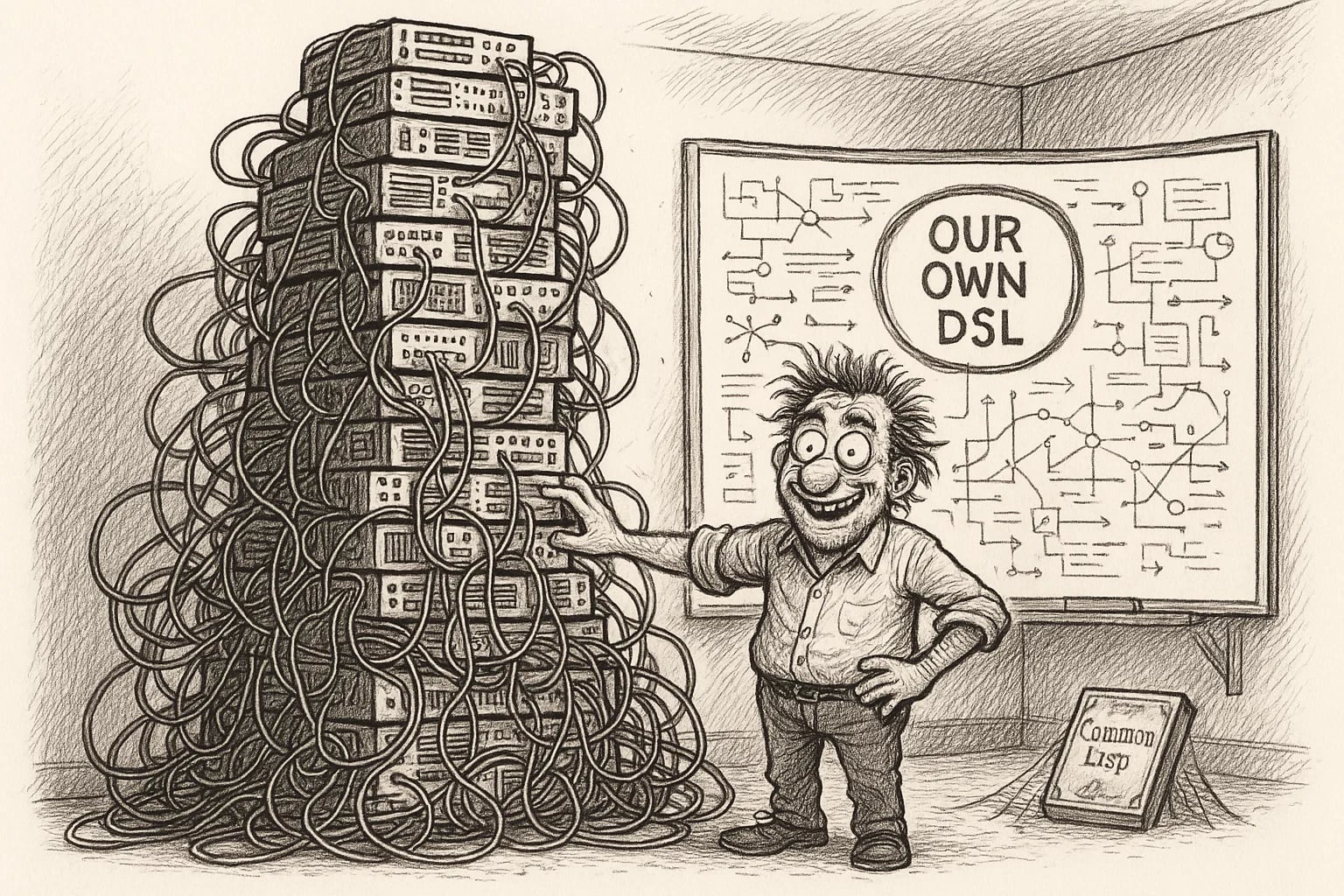
Greenspun’s Rule is the cruel prophecy that any attempt to stuff higher-level abstractions into a low-level language eventually mutates into a bad Lisp impersonation. Why reinvent the wheel? Because you needed macros yesterday, someone muttered “we should write our own DSL,” and suddenly your C codebase contains a wobbly interpreter, half-baked garbage collection, and a configuration format that reads like ancient runes. It starts innocently — a tiny expression evaluator — and ends with an accidental, half-functional Lisp clone nobody asked for. The danger is that such ad-hoc languages are fragile. They lack specs, tests, and thoughtful design. What you’re left with is slow, bug-ridden, and loved only by the person who wrote it. The lesson isn’t “never abstract” but “think before you roll your own runtime.” Document it, test it, or radical thought: “use an existing tool that already solved the problem”. Otherwise, enjoy your bespoke Lisp clone. It’s a fine conversation starter at conferences and a guaranteed way to be the only person qualified to fix your production outages.
Atwood’s Law
"Any application that can be written in JavaScript will eventually be written in JavaScript."
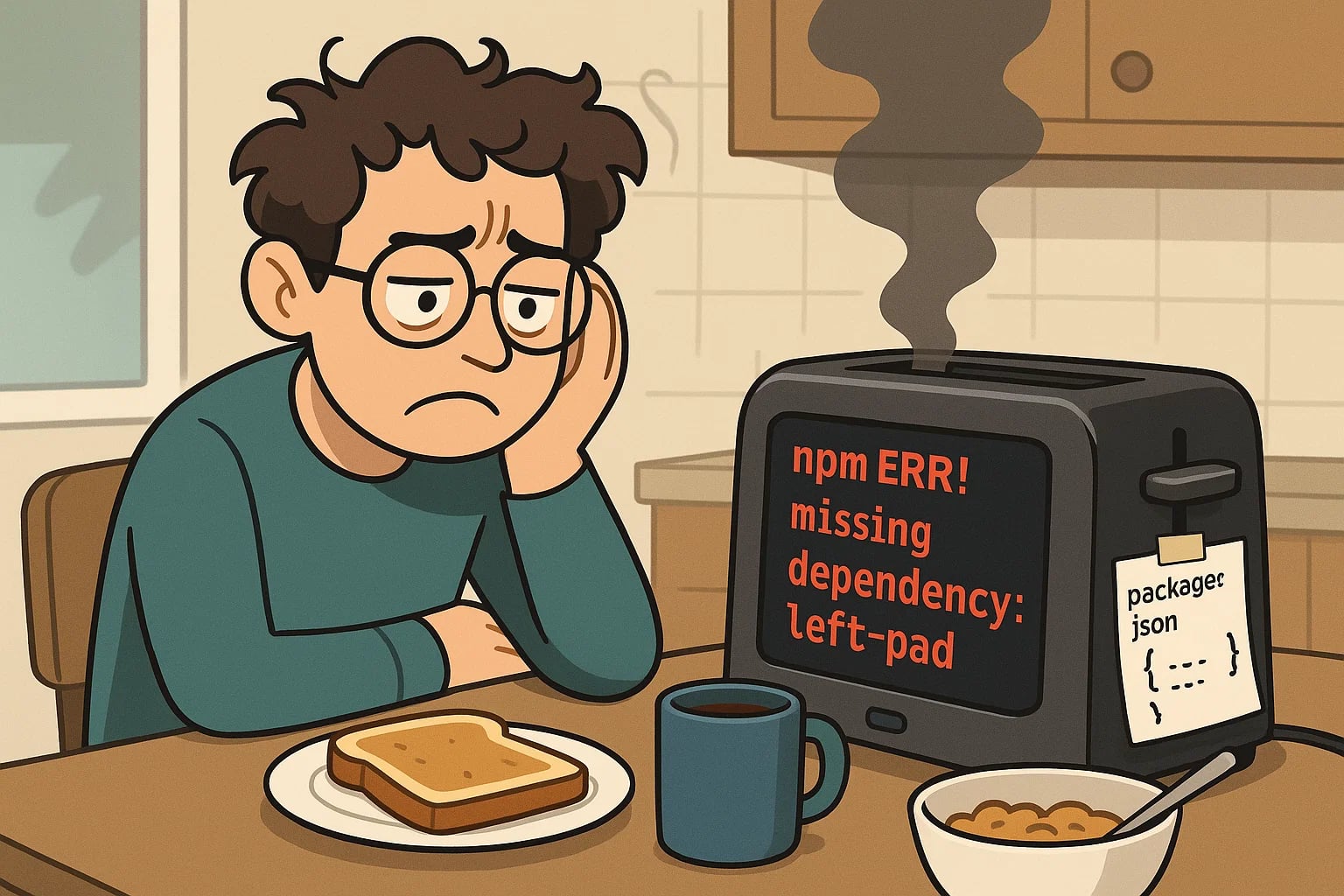
Atwood’s Law is both prophecy and diagnosis. JavaScript is everywhere because it runs in browsers and because developers love using one language across the entire stack. The result? CLI tools, desktop apps via Electron, serverless functions, and unfortunate forklift migrations to JavaScript. It’s practical, sure, but also terrifying. Your entire architecture can become a monolith of npm packages where one missing left-pad threatens to topple civilization. Why is this a tragic comedy? Because ubiquity breeds monoculture risks: dependency bloat, package abandonment, and performance surprises that appear at the worst possible moment. JavaScript’s ecosystem is amazing, but its gravitational pull ensures that if something can be written in JS, it will be even when it shouldn’t. If you’re lucky, you get rapid iteration and a massive talent pool. If you’re not, you’ll end up debugging why your toaster won’t start because npm install failed.
Final Thoughts (aka The Developer’s Daily Affirmation of Doom)
These laws aren’t fatalistic excuses; they’re a shared vocabulary for the mistakes humans (brilliant caffeinated humans) are destined to repeat. Recognize them, name them, and at least act surprised with style when they bite you. Real mitigation looks like testing, observability, honest estimates, product discipline, and occasionally the humility to pick an existing tool instead of inventing a shiny disaster.

If you want practical advice with this sarcasm garnish: deploy slowly, write logs that actually help, don’t waste months on logo debates while your app crashes in production, and never underestimate JavaScript’s talent for sneaking into places it doesn’t belong. And remember: if your project is mysteriously reading mail, you’re not cursed, you’re just honoring tradition. Welcome to the cult.